Wednesday, July 14, 2010
Laser beams sweeping the sky
A laser beam sweeping across the sky ... time exposure created the smoke like patches.[ Video]
Monday, July 12, 2010
Unmanned mini Space shuttle X37-B & a fireball later
A meteor streaked through the tail of Scorpion.. while i readied the field in anticipation of
the 2.9 magnitude X-37B to pass
On time down to seconds... X37-B arrived on time.
Saturday, July 10, 2010
Flashing space junk - yaogan(遥感) 1 deb
Flashing space debris ( passing gamma Aqr) on top right upper - overlay with background stars for position.
Closest match is Yaogan 1 debris ( 36363U 06015G ) ~ 6 seconds between flash. (Video)
Skymap Plot below
Iridium 17 gave out a single -2.29 flash
Friday, July 09, 2010
Sunday, June 27, 2010
Only one.. meteor and the partial lunar eclipse evening before
Sky stayed cloudy most of the time
Partial lunar eclipse 7:40pm - 9:00pm Saturday 6/26 - it was quite a sight with '50%' moon at ~ 20 degree elevation. Eclipse already at maximum coverage and shadow moving away from lunar. This time i used a pair of 10x70 binoculars to have a good look at the earth's curve shadow [ another proof that the earth is round ]. Mintron is too sensitive and depending what shutter speed you set the 'terminator' varies. Another star shared the same FOV in binos. Neighbors stood around at 12th floor common area chatting and enjoying the sight too. A quick refresher course of sun-earth-moon with our mother earth casting the shadow on lunar surface explanation was dished out. When i looked up again around 9:45pm everything was back in normal as if nothing had happened... it was just one of the numerous celestial alignment.
Sunday, June 20, 2010
Low pass of Hubble Telescope in Triangulum Australia - the southern triangle
HST - passing the southern triangle. Map courtesy of Heavens-above.com.
The 3.5+ mag Hubble Space Telescope making a low angle pass in the exposure below.
Monday, June 14, 2010
Sunday, June 13, 2010
Saturday, June 12, 2010
June 12 am '10 - meteors and Iridium 1/2 flare caught by chance
3 sporadic meteors in May 12 5:00-6:00 (+8) am hr slot..
Minutes after i set up the system around 8:22 pm I noticed the approach of a bright object at upper left corner and hit the rec button. A quick navigation to Heavens-Above.com confirmed my suspicion - it was a iridium flare. Iridium # 81 was on South bound and i just caught half a flare.
Saturday, June 05, 2010
Thursday, June 03, 2010
Wednesday, June 02, 2010
Cloudy sky and yet...
22:26 pm.. the system detected a bright slow meteor..
Earlier on, i was scanning the sky using Fujinon 10x70s. Looking at the Crux - Eta Carina areas. One sat drifted by the background stars and shortly after a yellowing white meteor with fringing green zoom pass the 5 degree pass FOV.
Tuesday, June 01, 2010
Sunday, May 30, 2010
Sunday, May 23, 2010
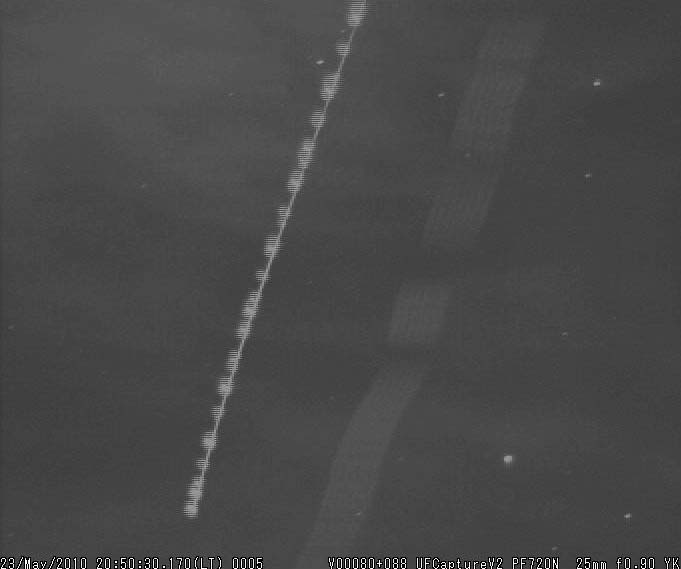
Commercial Jet - Contrails @ night
A slow passing Jet left a bright string of flashing lights. In this 5 minutes exposure a previous jet's single contrail was ribbon-ed and broaden by upper atmosphere lateral air flow with surprising pretty uniformity. Its less chaotic than i thought.
May 23 2010 Spos
-2.3 Magnitude SPO with another dimmer one
Three meteors ( all Sporadics) from above stacked frames. They all 'appeared' to come from the same radiant with the exception of the short one ( path length requirement). 2 trajectories so one backward projection intersect point ( RA 352.5 Dec=-42.3)...hmmm.
The 3 dotted stars on the mid right were Antares (SCO). VIDEO here
Sunday, May 16, 2010
May sky.. a couple of SPO - a nice x1 posted
a -1.3 mag sporadic ( SPO) 0:51am Sunday May 16 '10
Cloudy in the last few nites, so the moment i saw Crux and Pointers around 11:30pm Sat night i put out my system. Not expecting much activities - May is a quiet month. Bright and/or SPO is the target. The hunt continues
Couldn resist - another post of x1 SPO, this is brighter at -1.6
A good example of the benefit of using video. Imagine you are exposing using film, how do you know the background stars at time of exposure? In the video set up i always started with a few shots with background stars as reference... what if the sky was cloudy when i started the session? Then the second best thing is to enable the software to take a frame at certain interval e.g every 15 minutes. So say the sky clears up when you sleep.. the sampling will capture those ( as well as other bright fast moving objects). All the above is NOT a problem if you system is permanently mounted ( i.e fixed azimuth, elevation) - you only do the background ONCE! It still works for me in ad-hoc mode after all these years!! Video uploaded here.
Friday, May 07, 2010
Eta Aquarids May 7 2010 - bright ones in 5am-6am slot
( 5am - 6am) the captions should says 3,8mm f0,8 lens
See the negative magnitude eta Aquarids above!! video of these five here.
05:22:37 (-02), UT May 6 21:22
05:25:26(-1.4),UT May 6 21:25
05:32:49(-0.8),UT May 6 21:32
05:33:32(-2.0), UT May 6 21:33
05:55:35(-1.5). These are located in or near Sagittarius / Scorpion region. One overlay map plot below
6am - 6:30m ( above)
Before the Moon enter the video lens FOV ( 04 am- 5:00am slot)
For comparison - you are invited to check out last year Orionids captured using the same setup.
Orionids ( November) and Eta Aquarids( May) with similar parent body - Halley's Comet.
Thursday, May 06, 2010
Eta Aquarid ( Halley's comet Debris ) may 6 2010 & iridium 33 flashes ( after collision with cosmos 2251)
Posting individual frames showing the verified eta Aquarids in reverse timestamps order. If not for the automated detection system i doubt any one will bother to waste sleep on week day night to watch this shower with lunar light interference
A eta aquarid grazer.
BONUS visitor : Iridium 33 bright flashes after collision ( collided with Cosmos 2251 in 2009 Feb 10@ 1655UT over Siberia). Instead of total annihilation, the big piece of wreckage* still harbor the reflecting surface (MMA or solar panel that give rise to intense flashes) see in the above image. One tiny flash follow by a big one. *verified by ground level telescope imaging. Video of above flash.
Subscribe to:
Posts (Atom)